
Providing authority with IBM Sovereign Core
When digital sovereignty first came up in discussions, it was initially viewed mainly as a compliance issue.
That view now feels too narrow. Listening to customers, industry leaders and IBM has changed how I think about the subject. The central question is not simply where data sits. It is who has authority over the systems an organisation depends on.
That authority covers more than infrastructure ownership. It includes administrative access, operating responsibility, technology choices, AI models, audit evidence and the freedom to respond when circumstances change.
Put simply, an organisation needs to know who controls its digital future, and whether that control would hold up under pressure.
Why the discussion has moved beyond IT
Cloud adoption was driven by sound reasons. Organisations wanted speed, scale and access to services that would have been costly to build alone.
Those advantages have not disappeared. The concern is the dependence created alongside them.
Geopolitical uncertainty, cyber risk, regulation, AI governance and business continuity now sit in the same conversation. As a result, sovereignty has moved from a technical design point to a question of business exposure. A board does not need to understand every platform component, but it does need a clear answer on control, resilience and accountability.
Data residency is part of that answer, but it is not enough. An organisation might know the country in which its data is stored and still lack clarity on basic operational questions:
- Who operates the platform and holds privileged access?
- Who decides where AI inference takes place and which models are used?
- What information is available to AI agents?
- Could critical workloads move if the legal, commercial or political position changed?
- Is there current evidence that controls are working, rather than an audit snapshot from months earlier?
Those questions expose the difference between locating data and retaining authority over the wider environment.
Four parts of digital sovereignty
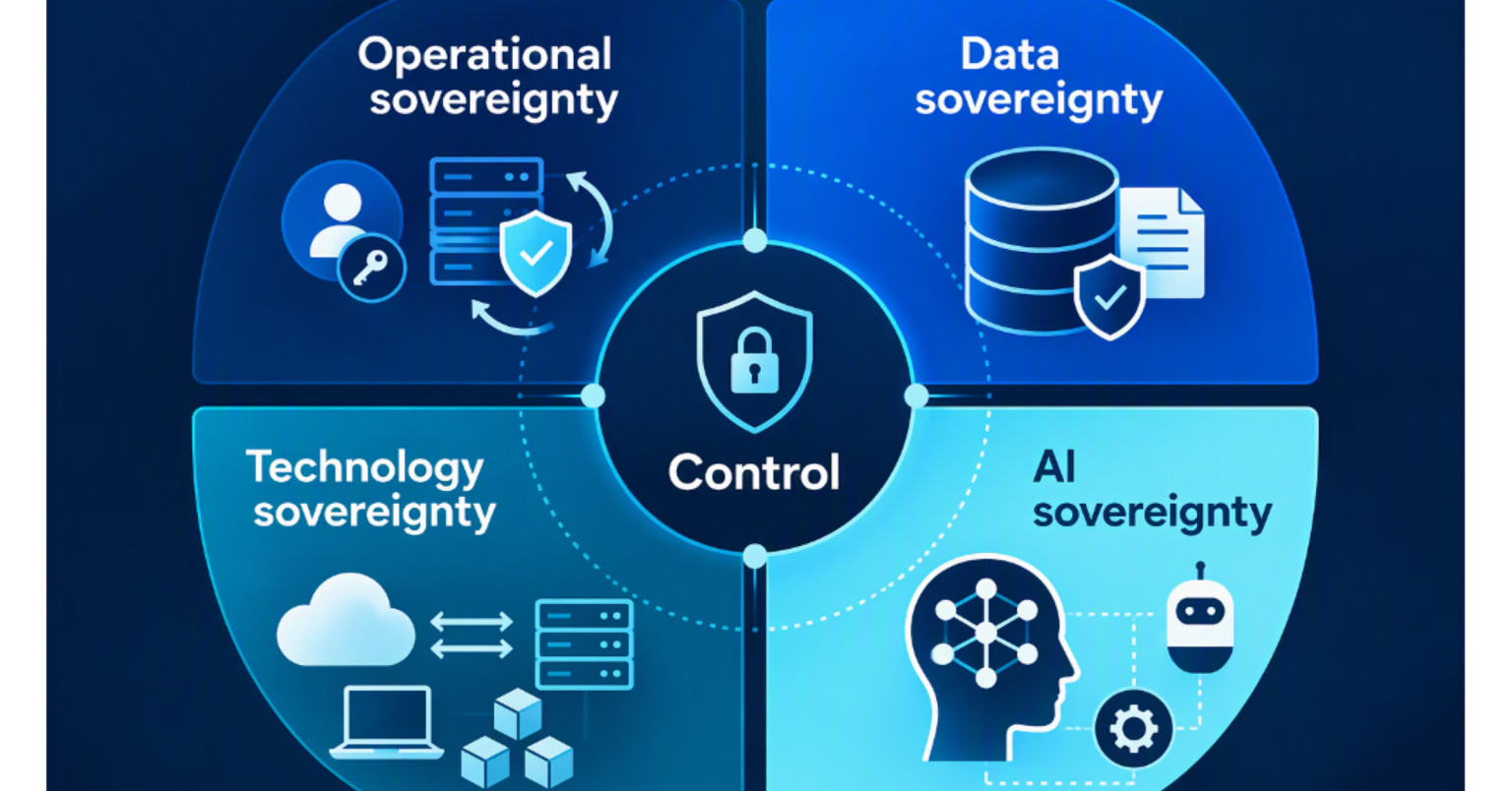
IBM describes digital sovereignty through four related areas: operational, data, technology and AI sovereignty. This division is useful because it prevents the discussion from collapsing into a single data-location test.
| Operational sovereignty | Who runs the environment, who has access and how services continue during disruption. |
| Data sovereignty | How data is stored, processed, governed and protected under the rules that apply to the organisation. |
| Technology sovereignty | The degree of choice an organisation retains over platforms, infrastructure and future change. |
| AI sovereignty | How models, agents and inference are governed, traced and kept within agreed boundaries. |
Although distinct, these four areas overlap. A portable technology stack supports operational choice. Operational controls protect data. AI governance extends the same discipline to models and agents. Weakness in one area tends to limit the others.
The rapid adoption of AI makes this more urgent. Once AI moves into business processes, organisations need firmer answers on model selection, inference, agent permissions and decision records.
Protecting the training data does not settle those questions. The organisation also needs authority over how the AI service behaves in production.
Policies are useful, but evidence is better
Another key theme is the move from written policy to operational proof. Contracts, governance frameworks and periodic audits still matter, but they describe intent or provide a point-in-time view. They do not always show what is happening now.
Many organisations already have controls. The harder task is showing that those controls remain active, measurable and auditable.
This changes the sovereignty discussion. The focus moves from writing another policy to collecting evidence from the environment itself.
That is a more demanding standard, but also a more useful one. When a regulator, customer or internal risk team asks for proof, the answer should come from current operating data rather than a collection of assurances.
Where IBM Sovereign Core fits
IBM positions Sovereign Core as an operating platform built around this requirement. It is intended for AI-ready sovereign environments across customer-owned, partner-operated and service-provider-managed infrastructure. The aim is to place sovereignty controls in the architecture from the start, rather than add them after deployment.
Four points in IBM’s proposition deserve attention.
1. A common sovereign software stack
Sovereign Core provides a consistent stack for different operating models. A customer, partner or service provider may run the environment, while the control model remains part of the platform design. Starting with those controls avoids the cost and ambiguity of retrofitting them later.
2. Compliance evidence from live operations
The Compliance Center is designed to monitor controls and collect evidence against regulatory and industry frameworks. The value lies less in another compliance dashboard and more in the shift towards continuous audit readiness. Evidence is gathered as part of operating the platform.
3. Governed AI services
Sovereign Core also addresses models, inference and agents. IBM’s proposition is that these services operate within defined sovereign boundaries, with traceability and governance attached. This matters because AI sovereignty depends on control of the whole service, not data storage alone.
4. Openness and portability
IBM links sovereignty to choice. Open technologies and infrastructure flexibility are intended to reduce dependence on a single operating model and give organisations room to adapt when commercial, regulatory or geopolitical conditions change. Portability is therefore a risk-control measure as much as a technical preference.
What this means for IBM Business Partners
For IBM Business Partners, the useful starting point is the customer’s risk, not the product label. Existing conversations about cloud modernisation, AI, resilience, regulation and managed services often contain a sovereignty requirement, even when nobody uses the word.
A managed service provider might focus on operational control and evidence. A systems integrator might address portability and architecture. A national cloud provider might combine local operations with governed AI services. Partners working in regulated industries may bring these elements together around a specific workload or regulatory obligation.
This also requires some discipline. Sovereignty should not become a broad claim attached to every cloud or AI proposal. Partners need to define the boundary, identify who holds each form of control, and show how the design proves those claims. Without that detail, sovereignty risks becoming another label.
A better customer conversation
Digital sovereignty has moved way beyond a debate about keeping technology inside a national border. Location matters, but authority, evidence and choice matter too. The more useful conversation starts with the systems the customer cannot afford to lose control of.
From there, the discussion becomes specific. Who operates them? Who has privileged access? Which dependencies would be hard to replace? How are AI decisions traced? What evidence shows the controls are working today?
IBM Sovereign Core attempts to provide an architectural response to those questions. Its relevance will depend on the customer’s operating model, regulatory position and risk tolerance.
For partners, the opportunity is to help customers turn a broad concern about sovereignty into a design that assigns control clearly and proves it in operation.
About the Author
Francis Rooney is a Technical Pre-Sales Consultant at TD SYNNEX and a trusted advisor to many IBM Business Partners across the UK. Working across IBM’s software portfolio, Frank helps partners turn technical challenges into practical solutions. From pre-sales support to navigating new technologies, his focus is on helping partners build confidence and deliver successful customer outcomes.